The Fiber Press
Fiber Art · Macramé · Cord & Tension · The Grammar of Making · For Those Who Make
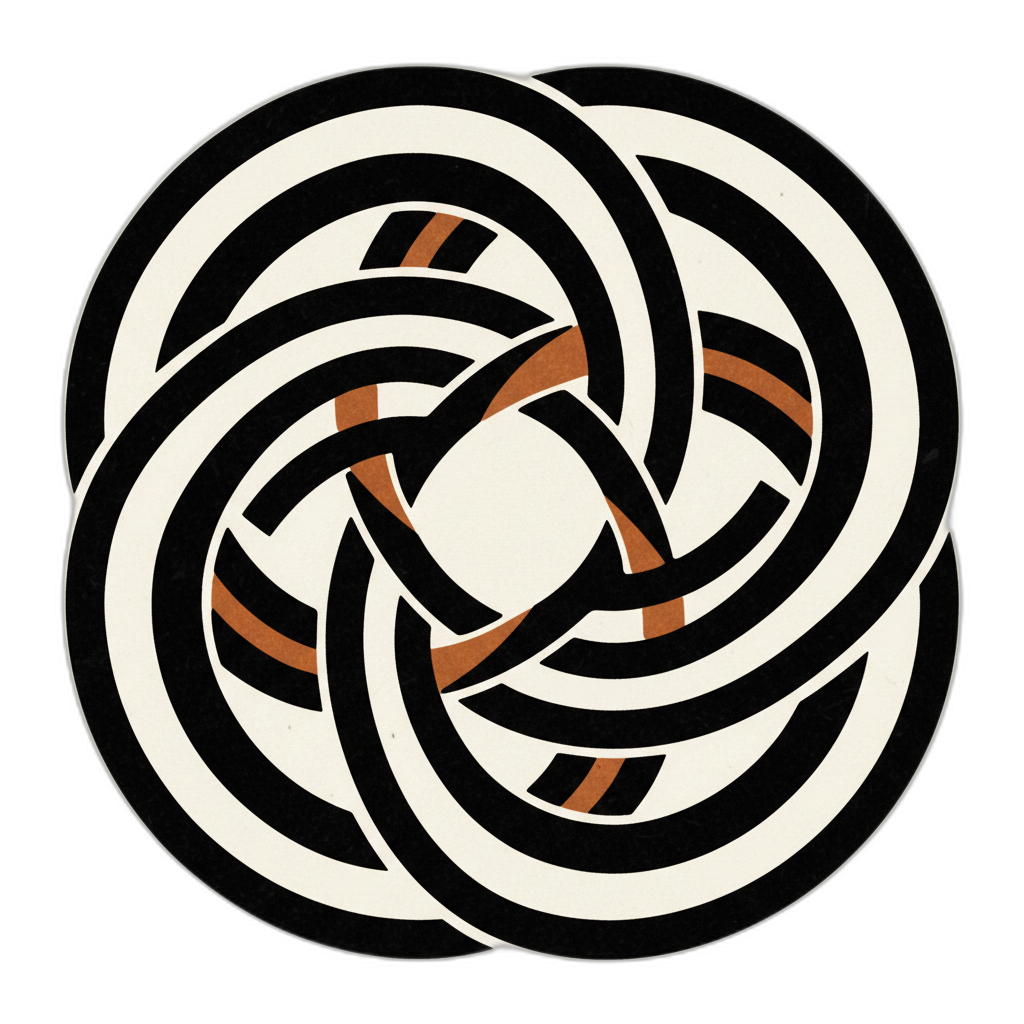
Woodblock No. 1 — "The First Knot"
Rendered in single-color sumi ink. Original study, 2026.
Inside This Issue
Lead Feature · Fiber Arts Education
You Were Never Meant to Sit Still.
A course that teaches hands to think — fingers learning the grammar of cord and tension, translating flat rope into sculptural walls and statement pieces that make a room fall quiet.
There is a particular silence that falls when you pull a cord through a loop and feel it catch. Not the silence of emptiness — the silence of a room holding its breath. Of something becoming. This is what fiber art is, and no one has ever taught it to you properly.
The craft world will tell you macramé is a hobby. Something for Sunday afternoons. A project. We disagree with some conviction. Rope is a language older than alphabets. Sailors read it with their eyes closed. Weavers built civilizations on it. What you are about to learn is not a technique. It is a grammar.
Knot is an eight-module online course for people who have always made things in their heads but never known where to put their hands. The curriculum moves from a single overhand knot to full sculptural installations — not as steps on a ladder, but as sentences in a longer conversation. Each module builds fluency. Each project is a paragraph.
"Rope is a language older than alphabets. You are about to become fluent."
For the In-Between
Between careers, between identities, between the person you were and whoever you're becoming — Knot meets you there, in the middle, with something to hold.
For New Mothers
An hour that is entirely yours. No one needs anything from it. Your hands remember how to make before your mind does.
For Designers
Stop sourcing fiber art. Start signing it. The gap between taste and authorship is eight modules wide.
The Fiber Press · Articles & Studies
Pages 2 – 7
Essay · p. 2
Fiber Art Is Not Craft. It Is Language.
Every civilization that lasted left fiber behind. The Incas wrote census data in quipu knots. Sailors navigated by the tension in a line. Weavers encoded cosmologies in cloth. What we call "macramé" is the diminutive of something vast. This course restores the grammar.
¶ Philosophy
Study · p. 3
The Overhand Knot: A Sentence.
Before you can write, you learn letters. The overhand knot is your first letter — closed, complete, self-referential. Module One begins here and goes nowhere else for three full sessions.
¶ Curriculum
Dispatch · p. 4
On the Quiet Revolution of Making Something.
There is a politics to handwork that no one discusses in polite company. When you make something with your hands, you opt out of consumption and into authorship. That is not nothing.
¶ Manifesto
Student Plate · Issue I
Wall Hanging No. 7, Cohort Zero.
Photographed on raw linen. Natural cotton cord, 4mm. Dimensions: 90cm × 140cm. Student: M. Tanaka, enrolled week two, completed week six.
¶ Student Work
Note · p. 5
Why the First Cohort Will Be Small.
Twelve students. Not because we cannot accommodate more — because fiber art is learned in the periphery of attention, and that requires space. The second cohort opens when the first one finishes.
¶ Program
Theory · p. 6
Tension Is the Whole Conversation.
Cord has no opinion until it meets resistance. The knot is the argument between fiber and force — and you are the moderator. Learning to feel tension is learning to listen.
¶ Technique
The Fiber Press · Letters to the Editor
Pages 11 – 12
Letter No. 4 · Vol. I
Dear Fiber Press,
I enrolled in the cohort zero pilot with no expectation beyond having something to do with my hands during my daughter's nap hours. By Module IV I had a wall hanging in my kitchen that three people have asked to buy. I told them it was not for sale. I meant it.
With gratitude,
Priya Mehta
New mother, Mumbai → Toronto
Letter No. 7 · Vol. I
To the Editor,
I have been specifying fiber art in residential interiors for eleven years. I know the vendors, the price points, the lead times. What I did not know was how the work was actually made. Module V changed the way I see every piece I specify. I have since made two of my own for client installations. I signed them.
Regards,
James Okonkwo
Interior Designer, Lagos
Letter No. 2 · Vol. I
A note,
I left a decade in marketing to figure out what I actually wanted to make. Knot was the first thing in three years that made me feel like I knew what I was doing. The curriculum is not gentle — it expects you to think. That is exactly what I needed.
Sincerely,
Camille Rousseau
Career-changer, Paris
Letters have been lightly edited for length. Names published with permission.
The Fiber Press · Profile
Page 13
Ink study, 2026. Studio portrait.
Profile · The Instructor
Noa Bergström
Fiber Artist & Educator
Noa Bergström learned to knot in her grandmother's kitchen in Göteborg, watching rope become something else entirely. She spent a decade working as a textile designer before she understood that the most interesting work happened before the loom — in the hands, in the cord, in the decision of where to place a knot and where to leave space.
She has taught fiber arts in studios in Stockholm, Kyoto, and Cape Town, and has exhibited large-scale installations in twelve galleries across four continents. Her work is in the permanent collections of three design museums. She teaches Knot because she is tired of watching talented people apologize for wanting to make things.
Her method is rigorous without being prescriptive. She will teach you the rules so that you know which ones to break. She will tell you when your tension is wrong and why it matters. She will not tell you what your work should look like — that is the only thing she cannot teach, and the only thing worth learning.
"I am tired of watching talented people apologize for wanting to make things. This course is the end of that apology."
— Noa Bergström, The Fiber Press interview, 2026